Kong: Skull Island – Review

“Let’s face it baby, these days, you gotta have a sequel,” to paraphrase Stu from the 1996 film Scream. If that was remade today, it’d be something like this: “‘cause let’s face it baby, these days you gotta have a shared universe.” Thanks to Marvel’s unprecedented success at juggling many balls in one massive shared cinematic universe, every studio and its dog is trying the same trick.

The latest Ghostbusters was supposed to launch a shared series of films. It failed. Of course, DC is trying the same. It’s struggling. Legendary is trying its hand with a MonsterVerse, which brings us to the relaunch of King Kong. This trip to Skull Island is primarily to familiarise the audience with King Kong in the universe that 2014’s Godzilla took place in.

The opening credits use the same montage technique as the Gareth Edwards monster film but there is no direct connection, Godzilla showed the years 1954, 1999 and 2014. Kong’s tale predominantly takes place in 1973 (after seeing a US pilot and Japanese dogfight counterpart crash land on the island in 1944).

The premise being John Goodman’s Bill Randa wants to travel to an island that defies detection. He’s convinced – because of something he saw as a child – that prehistoric animals exist in the modern day. He thinks Skull Island is a haven for them. Of course, he’s correct, and the island isn’t just home to a massive monkey. There are things that make the dinosaurs look fluffy.

Randa uses the end of the Vietnam war to leverage the powers that be to use the returning military for a little excursion. Enter a team. Shared universes need teams, even if the decades that divide the movies means it’s a onetime shot.

Tom Hiddleston is James Conrad, a former SAS man turned mercenary, reminding us why he can never be James Bond. Brie Larson turns up as photographer Mason Weaver. She is a do-gooder that has been on the cover of Time and is looking for the next big shot, regardless of the danger. And we have Samuel L. Jackson playing Preston Packard, the leader of the squadron assigned to land on the island.
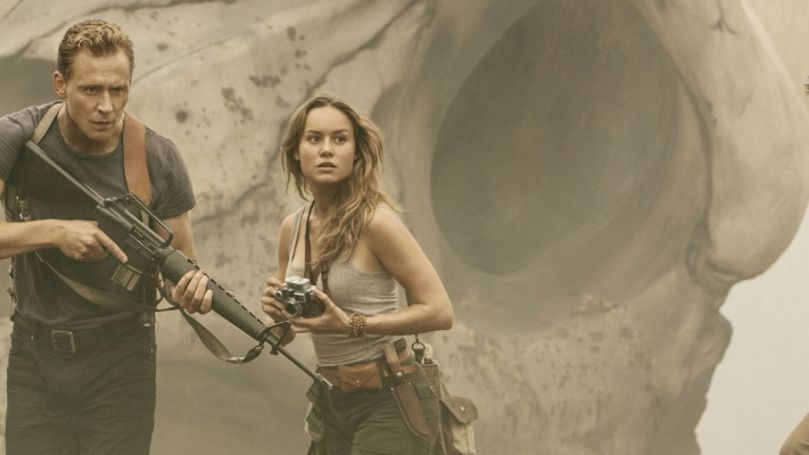
Brie Larson Hiddleston Kong Skull Island

Along for the ride are a few scientists, their biggest contribution is discovering we live in a hollow world. Yep, we can forget science when given massive monkeys with five fingers. Do we need pseudo-science to makes sense of it? Clive Balls does believe the world is flat, so perhaps some people will buy into this. Plus, it could explain the appearance of further beasts in upcoming Godzilla films.

Because the scientists need to probe, they dropped seismic charges to determine the composition of the land mass. Or as they appear to Kong: bombs.

There is no slow build-up and a big reveal to Kong like in all of his previous outings. Here, the King is front and centre from the off. He takes out the incoming helicopter squadron with ease. The moment is perhaps to pay homage to the original battle from 1933 on the Empire State Building. If so, all it does is alert us to the fact there is no tension or investment.

The survivors meet up with that crashed 1944 pilot, he turns out to be Hank Marlow, played by comic actor John C. Reilly. He provides relief in a film that doesn’t really need any. Godzilla (2014) was criticised for being too dark. It literally lacked a colour palette. This movie goes too far in the opposite direction.

The banners on buses and building gave us the hint. Those garish colours fill the big screen. What it loses in mood swings it toward cartoon. In doing so, the characters follow suit. Samuel L. Jackson, as well as reusing his own lines from Jurassic Park, and paraphrasing himself from Pulp Fiction, becomes the single-minded human antagonist.

He’s miffed Kong killed his invading crew. Hank Marlow explains, Kong keeps the dangerous monsters at bay and the island’s indigenous people safe. Jackson doesn’t care. It’s as unrealistic as his pouch – something a soldier returning from years of war in Vietnam just wouldn’t have.

Director Jordan Vogt-Roberts must have had a checklist of classic Kong shots – like the blonde woman lay in King Kong’s open palm – but he missed the vital element. Kong’s powerful scenes work when you feel for the character. In this outing, we don’t have time to care for the big guy.

And Brie Larson, arguably the most talented actor in the film, can get the damsel in distress and looking up in awe facial shots down to a T all she wants, it means zero if the world she’s working in is soulless.

The action is visually perfect, the actors do their best with a limited script, but it lacks the intelligence Gareth Edwards’s Godzilla strived for in pursuit of a more accessible action flick. I hope to see Kong again, next time I hope he reminds us why we used to care.

6/10

Logan (2017) – Review

If Get Out sold us short on the trailers, then Logan reset the balance. We know it’s Hugh Jackman’s final outing as Wolverine, and the arrival of young girl in the said trailers indicates X-23 is likely to be brought into the X-Men cinematic universe. It’s also clear we’re heading for a serious drama, less superhero feast. Knowing all this doesn’t detract from what we’re given.

Many are saying we should thank Deadpool for Wolverine getting – at last – an adult movie. Let’s face it, his previous two solo outings were subpar. And that’s being nice about it. The studio told director James Mangold and Hugh Jackman to make the film they wanted. Why don’t studios just do this all the time?

We find an aged Wolverine in a future where mutants are a distant memory. The disappearance of those with special abilities is explained clearly. Richard E. Grant’s Zander Rice has developed the vaccine earlier X-Men films fought against. He describes getting rid of them no different than curing Polio outbreaks.

The aging of Wolverine is a little less clear. We’re led to believe that perhaps it is the adamantium slowly poisoning the body, acting as a cancer. This just doesn’t wash with me. Sorry. But he’s had it long enough to dispel that theory. However, we have excused the fact his adamantium magically reappeared at the end of Days of Future Past so we can just accept the idea he’s not in the best of shape.

Neither is Professor X. He’s being kept locked away in a metal container, on lots of meds, to protect the world from his brain. See, it’s a massive problem if your head is classed as a weapon of mass destruction but you’re suffering from Alzheimer’s Disease. Logan’s joint carer for Charles Xavier is Stephen Merchant’s Caliban.

Quick segue here, so Tómas Lemarquis played Caliban in the very average X-Men: Apocalypse. The two versions in no way can be married up. It’s effectively a different character with the same ability (they’re trackers, in Logan, Caliban is captured and used to track the escaping Wolverine(s) and Professor X). It raises the question: Is Logan really canon?

It feels like a set-up for a continuation or a spin-off but could remain standalone. The future of mutants is preserved because Zander Rice has been attempting to weaponize strands of DNA with powers. Hence the arrival of the excellent Dafne Keen as Laura, or X-23, or future Wolverine.

As the story unravels, and Logan tries to get Laura to her meeting place, we realise some of these children have been saved from the clinic. The displays of abilities are the only let-down of the movie. They are clearly working to a tight budget and it betrays the feel of the majority of the film. The legend of the X-Men has made it to comic book form, which Logan explains is overblown nonsense.

The idea the reality was grittier fits the grittiness we see for the first three quarters of the story.

The only other problem is the appearance of a younger, healthier Weapon X. The film didn’t need cheap parlour tricks to slow Logan down. But it does offer a mirror on his growing and real humanity. So perhaps it was a good move?

The catalyst and reason for Logan to open up to his feelings is, of course, Laura. She steals scenes without using words. As there ever been a child actor so expressive and effective? Not to mention kick-ass bad. She’s determined and also vulnerable, she needs Logan’s love.

Charles Xavier also prods the conscious of Jackman’s character. Here it is touching as we see two old friends, with years of history, care for one another. Logan looks after his body and protects his mind. Not just from destruction but the truth of some unknown atrocity Professor X is guilty of committing.

In return Charles reminds Logan he is good. He can be saved.

The tone of Logan is perfect and as the main X-Men franchise loses its spirit and becomes more and more the mindless blockbuster it once stood apart from, this is a reminder that the best comic book films are the ones with heart.

It is graphic in parts. The stall is set out in the first scene when Logan places his claws through the skulls of carjackers. But it is never played for the sake of shock. It’s a movie trying to be honest.

Patrick Stewart announced on The Graham Norton Show this would also be his last film connected to the X-Men universe. By the end, you can understand his reasoning. There’s nothing a future film maker will be able to offer that bests this complete picture.

It is a passing of the torch. In Dafne Keen’s hands, it’ll be carried safely.

9/10

Ghost in the Shell (1995) – Review

With the new Hollywood remake out in cinemas, it was inevitable the Manga original was going to get a revisit. Or for some, a first viewing. The new Ghost in the Shell is best-known – for the time being, at least – for being responsible for reigniting the whitewashing in American movies. The original was the attempt to penetrate the western mainstream. It failed. But was it fairly overlooked?

It’s interesting when you ask people about Manga. Some will mention Akira before tailing off. Many recognise the niche films as a mark of honour. A nineties cult that defined a new type of geek-cool. For our in-house WWE expert, Clive Balls, who spent time living in Japan, they are more than quirky, in many ways they already trump Hollywood.

To the man in the middle (me), they are somewhere in between. Atmospheric animation that delves into thought provoking issues. They’re certainly not cartoons. They are the Japanese graphic novel without the awkward ties to forties comics.

Ghost in the Shell was a film ahead of its time. It took on artificial intelligence long before the current Westworld revival. It deals with gender and strips away all preconceptions long before the world at large listened to LGBT rights. The makers envisioned large networks and interconnectivity while we were all accessing the internet with dial-up.

The story centres on Major (she’s the Scarlett Johannson character). An outwardly looking female but her nakedness that reveals the dream body is purely to activate camouflage. The strength she displays and all her drives are asexual. She is something else in a world where cyborgs are commonplace, each believing they possess a soul – the ghost in the shell.

A complex argument of what defines consciousness, the individual traits that are left behind, creating the person.

As revelations unravel, Major worries that her ghost could just be clever programming. This comes about when her unit, a government agency, realises a hacker is at work, it appears the corporation that makes government cyborgs has been infiltrated.

The Puppet Master, is the name the hacker goes by, and it sets Major up for a showdown. With it, a deep insight into her own existence.

To go into further detail will unravel the apex of the story. The main takeaway from Ghost in the Shell after all these years is that the mood and feel stands up to anything that has come since. Some hallmarks have been outright robbed in major Hollywood films. The way characters move during action scenes is now the way CGI enhanced stuntmen do combat.

The soundtrack could be where Manga borrowed ideas from western sci-fi, even when using traditional Japanese songs, in terms of tension building. But the pacing is a let-down. The philosophical statements are unlikely to be surpassed in the 2017 live action remake but the flow of the film has room for improvement.

To answer the question in the opening paragraph: Yes, originally it was overlooked when it should have been embraced rather than copied. But time has aged some of its parts and degraded the once four-star film.

6/10

The Lego Batman Movie – Review

After 2016’s flurry of superhero films, this year promises to keep up the trend. Before the world feels burnt out with them, Warner Bros. hand over their prime property to The Lego franchise. Before we get more of the Ben Affleck Dark Knight, we get Will Arnett’s light-hearted brick version.

Criticism Marvel fanboys aim at their DC counterparts is they are too serious and dark, that comic books should be fun. It’ll be interesting to see how they deal with The Lego Batman Movie. Sure, it’s not a canon entry. It’s aimed at the kids’ market (some would say, this is Marvel’s core audience) but if you need the exact opposite of “serious and dark” then this is it.

Like the best of modern animation movies – looking at you Toy Story – there’s action for the kids and jokes for the parents. Lego Batman pleases the children with explosive action sequences, Lego being used and reshaped to create unique outcomes, and behaviour they can relate to. When The Joker fires his weapon, he makes little shooting sounds just like kids playing with Lego need to do.

The Lego Gotham City does feel authentic. You can tell what world we’re in. All the rogues are here too, proving that a good film can survive with an overflow of enemies. It’s clear from the start the movie’s makers are willing to point fun at the source material, and at first, having nearly every conceivable Batman villain on screen seems like a quick pun. But they stick around and The Joker manages to recruit even more bad guys.

Thanks to the Lego tie in, anyone that can be made from the little bricks appears. Even the Daleks show up, although never referenced by name.

The main story is how Batman is too withdrawn and refuses help. Cue Robin and new Commissioner and soon to be Batgirl, Barbara Gordon. Alongside this is how he breaks The Joker’s heart by denying him the title of main villain. He says he fights around, that there isn’t an “us.” It’s great humour that will probably fly over the heads of younger members of the audience.

To make Batman appreciate him, Joker hands himself – and all the villains in Gotham – over to new Commissioner Gordon. Batman, easily manipulated by his nemesis, doesn’t sit tight and starts a sequence of events that sees Joker release all the baddies from Superman’s Phantom Zone.

Suddenly Gotham needs Batman again but he can’t do it alone.

Usually kiddies’ films like this are big on the moral message and speed up the slower adult scenes. Here, even though the ideas it’s trying to tell are plainly obvious, they blend into the background. Early on the plot building will lose some younger viewers. Even when having fun, Batman has to be moody.

The Easter eggs, often in the form of one-liners, come thick and fast, and clearly are designed for older ears. The fun is bright and outlandish, satisfying the kids. The flashy sequences aren’t to cover any deficiencies in the cast either.

Ralph Fiennes does a great turn as Alfred, Michael Cera is back to form as Robin, and it’s a compliment to say you won’t realise (although, you will now) Rosario Dawson plays Barbara Gordon. Even the cameos go to big names.

It doesn’t pull on heartstrings like some animation movies nor is it a film made just for children. It’s not perfect but it works well and Bat-fans and kids alike will enjoy it.

7/10

A Most Violent Year – Review

Sometimes all the ingredients come along to make a modern day classic. We have Jessica Chastain, a strong showing from Oscar Isaac, JC Chandor pulling writing and directing duties, a moody 80s New York setting. Add to that an extensive out-pouring of positive critical reviews and nothing can go wrong, right? Wrong. All is not what it seems.

The premise is Isaac and Chastain play Abel and Anna Morales. Man and wife own and do the books for the Standing Heating Oil Company. While she’s juggling ever decreasing numbers on incomes sheets, he faces ever increasing odds to keep the company alive.

He wants to play it straight but his moral code is tested when his vehicles, containing the oil, are repeatedly stolen. With the loot missing, his financial situation is stretched. This becomes a vicious circle when he opts to purchase an oil terminal from a Jewish group but struggles to generate the required capital.

To make matters worse for Abel, David Oyelowo enters the fray as Lawrence who makes it clear he is investigating all his business deals. This prompts Anna to hide the books, even though they protest to playing it clean, and Abel feels the strain from all sides.

What follows is Abel facing attempted hits, one of his beaten drivers taking part in a shootout, and a race against time to keep his creditors at bay and get the cash for the terminal. The driver that secretly carried a firearm was Julian. The news of the impending criminal trial means the bank pull funding for the proposed oil terminal purchase.

Just what Abel needed. It also forms a subplot where Abel tries to find an on-the-run Julian so he can hand him over as a peace offering to Lawrence. Apparently, you’re not a tax evader if you give up gunmen.

It moves along with a steady pace but at times, not helped by the stylization, it feels more like a 70s TV detective movie than a well-produced blockbuster. The odd chase scene doesn’t levitate the film from its constant slumber. What we are left with is the hope Abel gets his money and identifies the thieves just to progress the story.

jessica-chastain-amvyMany people that have been wax lyrical over this have been seduced by the styling – and dare I say it? – believing that applauding this movie is some sort of reference point for being in the know. It’s a certain level of snobbishness that makes a person say this is a good film based on a below average script (it’s riddled with plot holes right up until the last scene), nostalgic cinematography, and a good performance from Jessica Chastain (when does she ever give a bad one?).

1981 may have been the most violent year on record in New York, this film however doesn’t reflect this. Everyone is in too much of a slumber to bother engaging in the violence we have to assume was happening all around them. It should be renamed: A Most Mundane Affair.

4/10