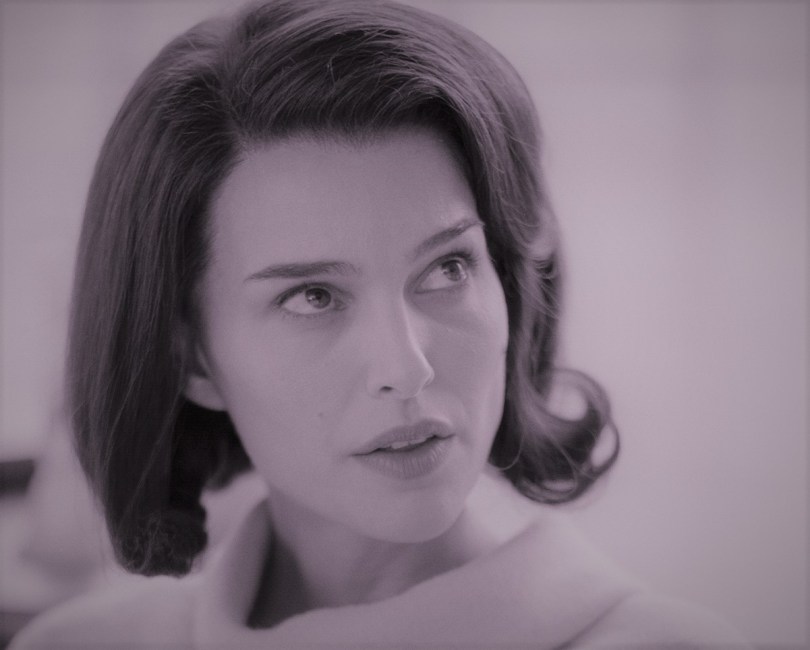
Jackie – Review

With the Oscars now on everyone’s mind, a movie comes along with an unexpected bang. Jackie is the biopic that gives perspective on Jacqueline Kennedy’s struggle following the assassination of JFK. Director Pablo Larraín and leading lady Natalie Portman combine to produce a film that is destined to take awards.

Straight out of the blocks, this becomes obvious. There should never be any doubting Natalie Portman’s ability. Her Academy Award for Black Swan was deserved, but after a minute of seeing her as the title lead, it’s clear she is about to scale new heights. She really is that good here. To say “engaging” is an understatement. Playing the woman that was once above every female on earth, she steals the big screen and makes a world that is all hers.

The narrative follows suit. Jackie is sat with an unnamed journalist, pouring her heart out while strictly editing what is permissible to print. This interview then cuts between events, before and after the death of her husband, even from one interview to another. It is cleverly edited to create a cohesive stream of consciousness.

It does make you wonder if it is a work within a work. We see her retell the story as she wants it now, laid bare, revealing her historical interview to be a fictional tale. It begs the question: is this just a new fiction, shaped by the passage of time?

If it is a less-than-true account, it doesn’t matter. The power of the ideals and ideas deserve this platform.

Watching it, you feel as if it is the sixties. Clever cinematography and an aspect ratio that won’t leave borders when it anamorphic widescreens to your telly to create the illusion. The performers use the canvas well. Any danger the attempt to make the past feel alive at the expense of a modern big movie experience is cancelled out by Mica Levi’s score.

A feel that is pounding with drama and driven by Jackie’s heartbeat is taken to a dramatic high with the soundtrack. Which is no mean feat when the leading lady delivers so much.

Portman gives a decade defining, generation setting, career high performance.

It’ll be a matter of opinion if the graphic scenes are gratuitous. The horror is at first hinted, then after living Jackie’s pain (through Portman’s perfect performance), finally revealed in full. Did we need to see it? Perhaps. Why should the viewer be shielded from that haunting vision after being an emotional vampire on Jackie’s neck?

The most famous assassination in history now has a story that isn’t interested in any conspiracy. It’s about what the focus should have been all along: real people coping with loss.

Surprisingly, the film is a 100/1 shot for Best Picture at the Academy Awards and Pablo Larraín isn’t even getting a mention for Best Director. Natalie Portman is currently second favourite behind Emma Stone for Best Actress. If she doesn’t take the award, it will be a travesty. Whether or not the film sits right with you, is paced correctly, or has the intended impact, is subjective.

What is factual is how Portman’s performance surpasses anything else we’ll see this year – potentially this decade.

9/10

A Most Violent Year – Review

Sometimes all the ingredients come along to make a modern day classic. We have Jessica Chastain, a strong showing from Oscar Isaac, JC Chandor pulling writing and directing duties, a moody 80s New York setting. Add to that an extensive out-pouring of positive critical reviews and nothing can go wrong, right? Wrong. All is not what it seems.

The premise is Isaac and Chastain play Abel and Anna Morales. Man and wife own and do the books for the Standing Heating Oil Company. While she’s juggling ever decreasing numbers on incomes sheets, he faces ever increasing odds to keep the company alive.

He wants to play it straight but his moral code is tested when his vehicles, containing the oil, are repeatedly stolen. With the loot missing, his financial situation is stretched. This becomes a vicious circle when he opts to purchase an oil terminal from a Jewish group but struggles to generate the required capital.

To make matters worse for Abel, David Oyelowo enters the fray as Lawrence who makes it clear he is investigating all his business deals. This prompts Anna to hide the books, even though they protest to playing it clean, and Abel feels the strain from all sides.

What follows is Abel facing attempted hits, one of his beaten drivers taking part in a shootout, and a race against time to keep his creditors at bay and get the cash for the terminal. The driver that secretly carried a firearm was Julian. The news of the impending criminal trial means the bank pull funding for the proposed oil terminal purchase.

Just what Abel needed. It also forms a subplot where Abel tries to find an on-the-run Julian so he can hand him over as a peace offering to Lawrence. Apparently, you’re not a tax evader if you give up gunmen.

It moves along with a steady pace but at times, not helped by the stylization, it feels more like a 70s TV detective movie than a well-produced blockbuster. The odd chase scene doesn’t levitate the film from its constant slumber. What we are left with is the hope Abel gets his money and identifies the thieves just to progress the story.

jessica-chastain-amvyMany people that have been wax lyrical over this have been seduced by the styling – and dare I say it? – believing that applauding this movie is some sort of reference point for being in the know. It’s a certain level of snobbishness that makes a person say this is a good film based on a below average script (it’s riddled with plot holes right up until the last scene), nostalgic cinematography, and a good performance from Jessica Chastain (when does she ever give a bad one?).

1981 may have been the most violent year on record in New York, this film however doesn’t reflect this. Everyone is in too much of a slumber to bother engaging in the violence we have to assume was happening all around them. It should be renamed: A Most Mundane Affair.

4/10

ITV WOS Wrestling – Review

New Year’s Eve saw ITV revive a nostalgic brand: World of Sport Wrestling. Those of a certain age will remember Saturday evenings watching Big Daddy, Giant Haystacks – and my personal favourite, who can probably take some credit for how I’ve spent my professional career hidden behind a mask – Kendo Nagasaki. It’s just dawned on me, my years chasing fame in Japan could be down to my first exposure to professional wrestling. The original WOS Wrestling was pulled in the mid-eighties, followed by Wrestling with Kent Walton. The question is: does the TV schedule have room for it today?

There was room for it back in 1988 when wrestling left our screens. Hindsight is 20/20 but producers must look back on that decision and kick themselves. A year later the WWE (then known as WWF) started its UK invasion. It grew so fast in popularity here, SummerSlam was held at Wembley stadium in 1992. Over 80,000 fans witnessed The British Bulldog Davey Boy Smith take the Intercontinental Championship from Bret “The Hitman” Hart.

Had a channel retained UK wrestling, maybe the WWE would have had a genuine transatlantic rival. We’ll never know, but by passing up on wrestling, the UK television networks gave up all creative control. Vince McMahon designed the blueprint, defeated his only challenger WCW (ironically, they aired on ITV in the nineties), and every wrestling organisation since has fallen into line.

ITV clearly has been watching WWE. From the opening minutes of WOS Wrestling it becomes obvious. The set has good production values, without the scale of WWE. It’s a mix of their take on Gladiators and a clinical TNA set. The game changer is having Jim Ross on commentary. The voice synonymous with a whole generation of WWE.

ITV may have watched WWE but what follows is veiled flattery. Vince’s outfit has gone from the cartoony version of wrestling it brought to the world when WOS Wrestling ended in the eighties, through the adult-rated Attitude Era, to the PG and Reality Era. That current landscape means a pre-watershed wrestling show can survive on telly. During this evolution the term: sports entertainment was coined.

The problem with WOS Wrestling is how it tries to pay homage to the old stars like Big Daddy with constant reminders, evoking nostalgia, but accidentally makes one nostalgic for an antiquated version of pro-wrestling in the form of old school WWF.

Nowadays a wrestling show is all about the storylines and mic work. ITV went for the owner angle, a Mr Beesley that ran things. Okay, so we get a British Jack Tunney. Beesley’s “office” was propped with posters indicating it was just a spare room at MediaCityUK.

The first match saw Grado get screwed out of the WOS Championship by bad guy Dave Mastiff. This, in itself, was great. Mastiff was the clear heel, he had two henchmen in tow and he and Grado told a classic tale of favoured underdog holding his own.

Nowadays clear heels and faces are rare in professional wrestling, this throwback was fine and a necessity with a less savvy audience. What wasn’t great was the way Beesley said he couldn’t let a screwjob stand for the title and declared Mastiff would defend it at the end of the show against the winner of a Battle Royal.

Okay, anyone that was watched wrestling long enough knows that if a title (in this case, the only title) kicks-off a show, we’re not getting a clean finish. So the surprise was gone from the off. The idea all dodgy finishes will be challenged is flawed. The acting with Beesley was from a bygone era.

And that is WOS Wrestling’s major problem. It doesn’t know if it’s a programme that should be like its eighties counterpart, or one that can be compared to modern day WWE.

They edged toward the latter with a ladder match. Kenny Williams took the result, he looked better than the rest based on ability and aesthetics. But the other three, CJ Banks, Sam Bailey (not The X Factor singer) and Delicious Danny, all deserve a round of applause for pulling off a dangerous match with tea-time restrictions.

The other main standout – no, not El Ligero, although he was good – was Alexis Rose. She looked the part and moved around the ring well. WWE’s current British female wrestler is in the bad books. Rose would be worth a shot in their performance centre.

alexis-rose

The Battle Royal had a secret entrant (that joined late for no good reason). It was The new British Bulldog, the son of Davey Boy, now using his name with Jnr added. He didn’t progress to the title bout. Presumably, ITV aren’t confident they could tie him down should the show go fulltime so can’t afford to have a champion MIA.

Of course, Grado won the Battle Royal and then the title match. Classic babyface overcoming the odds in the end. Cheating never pays, kids.

ITV must have an eye on a permanent return, why bring back the title otherwise? Based on this, there is plenty of potential that deserves exploring but they need a creative team more akin to the modern era of wrestling. Without this, WOS Wrestling would grow stale fast.

Promising but work to be done.

6/10

(Follow @MrCliveBalls on Twitter. He points out, he is available to do creative work for Sports Entertainment outfits.)

Rogue One – Review

Last year JJ Abrams gave us the soft reboot to the Star Wars universe. It got the ball rolling for Disney and now we get the first of the spin-off movies. It comes in the form of Rogue One, a true prequel to Star Wars Episode IV: A New Hope, as it tells the story of how the Death Star plans ended up in the hands of the rebels.

Felicity Jones plays Jyn (picture a diluted Rey). She isn’t force sensitive and has daddy issues like Luke Skywalker. A lot like Luke. It seems, to her, for some unknown reason, daddy has turned to the bad side. But we see at the start of the movie, he is reluctantly dragged away by the Empire to finish his work on the Death Star.

She has to go rogue (excuse the pun) as a kid, and is saved by an extreme rebel, Saw Gerrera. This character is played by the usually excellent Forest Whitaker. He isn’t so great here, it’s as if he took his (good) eye off the ball. The performance is somewhere between campy, empty, exaggerated.

Her father (like Luke’s, remember) is on a path to redemption and she’s the tool. TV’s Hannibal Mads Mikkelsen plays the role, he leaks a way for the rebels to get the blueprints to the Death Star and points them in the right direction when it comes to faults.

You know that major gripe about a super-space station being so vulnerable to what looks like a stupid oversight? Well, that is explained away: the designer put it there on purpose.

Mads as Galen Erso comes with only one complaint – we don’t get to see enough of him.

What begins as a darker Star Wars film, can’t help slip into a lighter version. In the final moments, I had to remind myself I wasn’t watching Star Trek Beyond. That’s right, the adult Star Wars film turns into the friendliest sci-fi of the summer.

It still manages to feel like it belongs with the original trilogy (blue milk, anyone?) and we do get some throwbacks. Peter Cushing is raised from the dead via CGI to resume his role as Grand Moff Tarkin. It’s a decent effort in terms of effects but he lacks the humanity, and the supreme acting ability, of the long-deceased legend.

He’s not bossing Lord Vader around this time, but Ben Mendelsohn’s Orson Krennic, who proves to be a worthy central, if slightly inept, villain.

Darth is back, in a few fleeting scenes. Vader now struts around like a catwalk model. Whoever says the fear factor has returned never appreciated seeing him for the first time before Lucas destroyed his mystique.

A hint of force sensitive individuals comes in the form of Chirrut Îmwe. He is a blind man that uses the force to be as effective as any fighter on screen. And fair play to Disney, they could have had him brandishing a light sabre in the final third but resisted. It means the idea that the Jedi are myth in A New Hope still rings true.

NB, George Lucas: This is how you avoid plot holes.

We know the ending, otherwise there’d be no A New Hope. How we get there is engaging. And like Star Trek Beyond, you’ll not think about it a few months from now.

It could be telling that it’s not had quite the same push as The Force Awakens. They’ve let this one out on its own merits, to find momentum under its own steam. A movie of two halves will leave all fans 50% satisfied.

7/10

(It’s touching, in light of recent events, that the final shot is a CGI Carrie Fisher as the original Princess Leia. May the Force be with her, always.)