Apple Tree Yard – Season 1 – Episode 3

It’s the show that continues to get better, episode-by-episode. The third instalment sees the real issues take centre stage. And it’s all the better for it. A show that was uncomfortable to watch in the first moments because it was cringe is now difficult because of the gravitas of its message.

Last week’s dart from George’s house is now explained. Mr Conspiracy here shouldn’t have focused on disinterested dogs in the window. That canine was conveniently ignoring a brutal beating that led to George’s death.

Yep, the “Spook” took things too far and ensured the rapist couldn’t bother Yvonne ever again.

The police pitch up when she’s in a restaurant with her family, where she shares a touching kiss with husband Gary, and arrest her on suspicion of murder.

Still, the law here says if they plotted it together, if she had foreknowledge, she’s as guilty as the man putting the boot in. For his part, Mark Costley pleads manslaughter on the grounds of diminished responsibility. Sprinkle in a personality disorder claim, and he was big step to avoiding a full murder conviction.

This should have all been great news for Yvonne. With Mark saying he lost his mind, and literally has a few personas on the go to lose, she has a stronger case to say she was unaware.

Wouldn’t make for great telly though, would it, a clear-cut case?
The problems arise when she posts bail (hubby generates £100k to do so) but she breaks the terms of it by responding to a Costley text message. That really was costly.

The courtroom drama was decent. It was interesting and gratifying to see Costley deconstructed. His character was always slightly off-kilter. Now we are made to question if this really is his persona. The links to the intelligence service are revealed: he failed selection.

This leaves Yvonne questioning everything she thought she knew while trying to maintain the façade they were just friends. That can’t end well . . . especially when Costley got a bit of the old green eye watching Yvonne interact with Gary in court.

7/10

Apple Tree Yard – Season 1 – Episode 2

After a dubious beginning, episode two of Apple Tree Yard dispenses with the elements that dragged it down and the main story starts to get traction. The payoff for this is the most uncomfortable twenty minutes of television I can recall ever experiencing.

Yvonne is trying her best to cope with the rape. She feigns illness to give herself space from her husband, while seeking counsel from Mark Costley. He hooks her up with an expert about how to proceed should she wish to prosecute George for the crime.

Problem is, time has elapsed, the DNA evidence now washed away, and he warns that her whole life would be placed under a microscope. This is enough to make her decide against any formal action.

She decides to leave her job and end the affair with Costley, explaining she can’t see herself ever wanting sex again and theirs was just a lustful encounter.

Another problem develops when it seems George is beginning to stalk her. He’s sending texts from unknown phones and flowers with quaint messages. So she turns to Costley for support. He is a Spook after all, right?

The series hinges on where it goes from here. As a viewer, suspicions should be high. Why couldn’t Costley – a would-be Bond – get to George straight away? When he finally pays him a visit, he casually walks into the house and the dog in the window never pays any notice (familiar face?).

We are reminded at the close of the show Yvonne is on trial in the future. But for what? Was she being used as a puppet of sorts or did she take revenge too far?

6/10

The Lego Batman Movie – Review

After 2016’s flurry of superhero films, this year promises to keep up the trend. Before the world feels burnt out with them, Warner Bros. hand over their prime property to The Lego franchise. Before we get more of the Ben Affleck Dark Knight, we get Will Arnett’s light-hearted brick version.

Criticism Marvel fanboys aim at their DC counterparts is they are too serious and dark, that comic books should be fun. It’ll be interesting to see how they deal with The Lego Batman Movie. Sure, it’s not a canon entry. It’s aimed at the kids’ market (some would say, this is Marvel’s core audience) but if you need the exact opposite of “serious and dark” then this is it.

Like the best of modern animation movies – looking at you Toy Story – there’s action for the kids and jokes for the parents. Lego Batman pleases the children with explosive action sequences, Lego being used and reshaped to create unique outcomes, and behaviour they can relate to. When The Joker fires his weapon, he makes little shooting sounds just like kids playing with Lego need to do.

The Lego Gotham City does feel authentic. You can tell what world we’re in. All the rogues are here too, proving that a good film can survive with an overflow of enemies. It’s clear from the start the movie’s makers are willing to point fun at the source material, and at first, having nearly every conceivable Batman villain on screen seems like a quick pun. But they stick around and The Joker manages to recruit even more bad guys.

Thanks to the Lego tie in, anyone that can be made from the little bricks appears. Even the Daleks show up, although never referenced by name.

The main story is how Batman is too withdrawn and refuses help. Cue Robin and new Commissioner and soon to be Batgirl, Barbara Gordon. Alongside this is how he breaks The Joker’s heart by denying him the title of main villain. He says he fights around, that there isn’t an “us.” It’s great humour that will probably fly over the heads of younger members of the audience.

To make Batman appreciate him, Joker hands himself – and all the villains in Gotham – over to new Commissioner Gordon. Batman, easily manipulated by his nemesis, doesn’t sit tight and starts a sequence of events that sees Joker release all the baddies from Superman’s Phantom Zone.

Suddenly Gotham needs Batman again but he can’t do it alone.

Usually kiddies’ films like this are big on the moral message and speed up the slower adult scenes. Here, even though the ideas it’s trying to tell are plainly obvious, they blend into the background. Early on the plot building will lose some younger viewers. Even when having fun, Batman has to be moody.

The Easter eggs, often in the form of one-liners, come thick and fast, and clearly are designed for older ears. The fun is bright and outlandish, satisfying the kids. The flashy sequences aren’t to cover any deficiencies in the cast either.

Ralph Fiennes does a great turn as Alfred, Michael Cera is back to form as Robin, and it’s a compliment to say you won’t realise (although, you will now) Rosario Dawson plays Barbara Gordon. Even the cameos go to big names.

It doesn’t pull on heartstrings like some animation movies nor is it a film made just for children. It’s not perfect but it works well and Bat-fans and kids alike will enjoy it.

7/10

Split – Review

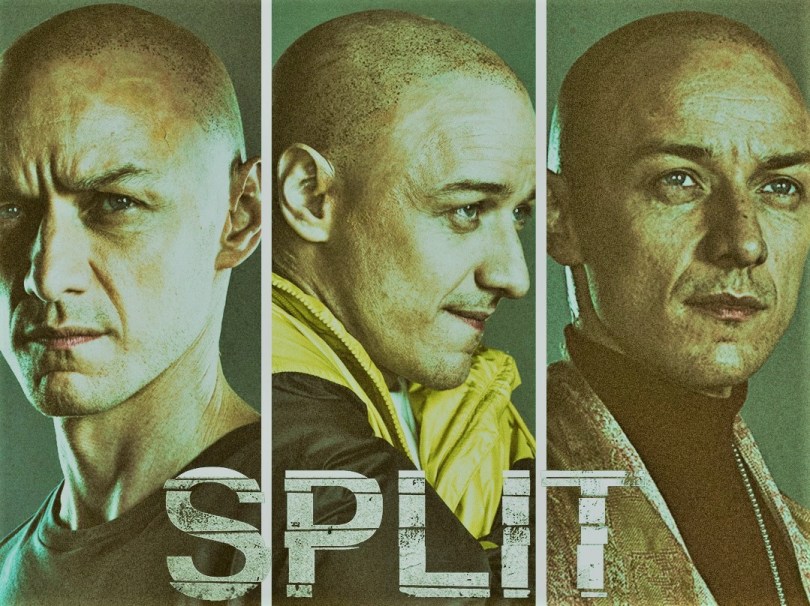
Going into a M. Night Shyamalan film nowadays comes with certain guarantees. You’ll have been wooed by the trailer, believing he’s back on The Sixth Sense sort of form. After an hour, you’ll feel the eerie creep of disappointment settling in. By the end, the “twist” will lead to abject dismay and a vow never to trust him again. But then he serves up James McAvoy playing a man with twenty-three distinct personalities.

So, we all jump aboard the Shyamalan train once again. This time we know from the adverts that McAvoy’s character kidnaps three teenage girls. They come in the guise of Skins’ Jessica Sula and her best buddy, Haley Lu Richardson’s Claire. When they’re nabbed, they are leaving Claire’s birthday party and have sympathy invite – and our lead protagonist – Anya Taylor-Joy’s Casey with them.

So far, so good. The build begins for a psychological thriller. We first meet Dennis, an OCD strict jailer. This personality is kept in check by Patricia, his female personality that helps run the gig. The plan is to feed the girls to The Beast, a yet-to-be-met personality that is above all humankind.

Do you feel that thriller swinging toward a horror?

In between captive scenes, we see Dennis parade as Barry to his therapist and seeks counsel. She totally buys the idea that within a person, multiple, completely separate identities can exist. She even gives examples how physiological changes occur depending on the personality assumed.

The host in this case is Kevin but he’s been overrun by Dennis and Patricia. The collective is known as The Horde. It’s explained they all sit around a circle waiting for their time in the light. Kevin’s nine-year-old personality, Hedwig, has the ability to control people’s slot in the light. He’s agreed to assist Dennis and Patricia because they prevent The Horde poking fun at him.

For a time, it becomes teen slasher. The girls try revolts and get put into solitary confinement. But throughout all the main actors do their roles justice. McAvoy is impressive carrying the load of diverse personas but it’s no Heath Ledger as The Joker. More, engaging performance amidst a struggling script.

When we finally get to meet The Beast, the movie becomes ludicrous. It’s okay to suspend disbelief if the requirement is made clear early on. But to start with a grounded tone, have scenes stressing the seriousness of dissociative identity disorder, to then descend into something that would look ridiculous in a modern-day comic book is almost unforgivable.

4/10 . . . if the film finished a few minutes earlier than it did.

Remember how M. Night Shyamalan likes to throw in a twist? Well, he does it again here. I’ll not ruin it for you but that “almost” before unforgivable is for occasions such as this. For the sake of a quick shock in the cinema, he would have been better just laying his cards out in advance. Doing so would have enhanced the viewing of the movie rather than numerous headshakes at the screen and the laughter it unintentionally provided in various scenes.

5/10 (Probably should be more after the final scene sinks in but M. Night Shyamalan has missed a trick.)

Apple Tree Yard – Season 1 – Episode 1

As part of the BBC Drama drive, Apple Tree Yard comes to our screens. The Louise Doughty novel it’s adapted from is described as an erotically charged thriller, can Emily Watson and Ben Chaplin bring that spark to the screen?

Watson portrays Dr Yvonne Carmichael, a clever geneticist that starts the episode giving a speech to a bunch of politicians in the House of Commons. When it ends, she gets chatting to Chaplin’s Mark Costley (Dickens-esq naming of characters?), rather than exit, he shows her to a secret area used for functions (even weddings).

In a broom cupboard, they have a good old fashioned quickie. To add a sense of spontaneity, Mark gets the job done with his foot in a mop bucket.

To be fair, at this point it feels charged enough. Had it lived up to the adverts, it would have been a good platform. But then the thriller of the novel becomes a soap opera. We see Yvonne unhappy at home, her husband is probably having an affair, so naturally she goes hunting Costley.

He likes danger sex in public, she just likes him. That’s what turns her on – him. She actually explains this to Mark. By the time he’s throwing another one up in Apple Tree Yard, you really don’t care if her marriage fails, who Mark Costley really is (she thinks he’s a “Spook” for MI6).

We know the story is told retrospectively as we saw the present-day Yvonne handcuffed at the start, so there had to be more to the story than an average looking middle aged woman having indecent sex in public.

Then comes a work’s party, her husband away, and a colleague named George that knows she’s having an affair and uses it as leverage to make a move on her. She rejects and a violent rape scene occurs. Being the BBC, we have to assume they would never use such a delicate subject purely for shock value but it’s misguided allowing it to take place in such a pedestrian and poorly conceived drama.

It gives Yvonne motive for revenge now but it’s distasteful that the BBC would use rape as a cliff-hanger for what’s to come next.

Hopefully the first chapter was an awkward world setting requirement and improvements are inbound.

4/10